Thursday, April 24, 2008

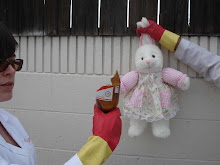
Aquifurry

Hi friends!! Want to know more about aquifers!? Good, I thought so.
An aquifer is typically some layer of permeable rock or unconsolidated material like gravel or sand wherein water that trickles down from the earth’s surface tends to hang out for a while. We like aquifers because by tapping into an aquifer via a well we get fresh water to drink, irrigate crops, cook, clean, fill water balloons, etc.

Aquifers can come in a couple of different flavors, two of which are confined and unconfined. A confined aquifer typically has a layer of finer grained sediments on top if it called an aquitard. This aquitard layer serves as almost a cap on the aquifer below it. Water can still permeate an aquitard, but it does so very…very…slowly. If water isn’t let through at all, the layer is called an aquiclude. Aquitards can be layers of clay or silt or whatever fine grained sediment you fancy.

Unconfined aquifers are just like what they sound: an aquifer that isn’t confined by an aquitard. These aquifers seem so footloose and fancy free. No, but they do contain water that is still a viable source for wells and such. Unconfined aquifers can sometimes be found living above confined aquifers, but below the water table. Think of unconfined aquifers as the confined aquifer’s noisy upstairs neighbor who’s always tromping around in high heels at all hours of the night. I have one of those neighbors. Man, I hate those jerks.
There's your quick and dirty look at aquifers. Ta-Da!


image ref: http://tinyurl.com/4cvhfy

Wednesday, April 16, 2008

Heeeyyyy, I know you

It's so good to see you! You look great, have you lost weight? Hmm? What's that? What have I been up to, you ask? Well, I've been really busy. I finished my thesis, helped write a funding proposal, went to a conference, got my PhD comittee squared away, went on some dates with some gentlemen, played some roller derby, ate some cheeseburgers, redecorated the apartment, bought a moped...oh, but enough about me. What have you been up to? Uh huh. Uh huh. Oh, my. In your head? The size of a walnut? That's terrible. Oh, ok. You've got to run. I understand. I'll see you again soon and I'll have more stuff to tell you. Right now I have to get to work on my thesis edits. Awww, I missed you too. I'll see you soon. Love, Paris.

Monday, January 28, 2008

Rock Haikus

They come from inside
They were molten, now they aren’t
They are igneous

Phaneritic rocks
Large crystals live in this kind
Visible crystals

Aphanitic rocks
Small crystals you cannot see
Small, like the aphid

Silica, felsic
Light color, low density
Continental Crust

Iron rich, mafic
Darker, higher density
Oceanic Crust

Igneous rocks have
many different names we learn
Vocab is a pain

Friday, January 11, 2008

And now for Box Models!

I’ve been set to the task of constructing a box model for my silica work in the North Pacific. A box model starts by thinking of your system as a 3 dimensional box, hence box model. Then you start adding up all the ways silica can enter your box and subtract from that all the ways silica can exit your box. Assuming that your box is in steady state (i.e.: there’s no tremendous buildup of silica in the box) then everything coming in has to equal everything going out. Simple, right?

Here’s my box model:Things going in = things going out. Now we get to apply numbers to this model and this is where I’m boned. The difference between choosing a number like 190 or 195 is a big deal in these calculations and to choose the right number means choosing the number my advisor can live with. I would storm on ahead and finish this already if only I knew that I wouldn’t have to do all this work over again once we decide that 192 is a more appropriate number than 193. And so, dear reader, such is the life of a graduate student. I guess we’ll have to find something else to do in the interim. Like read some science papers, but I’d rather watch baby monkey videos.

Tuesday, January 8, 2008

Sediments are so sedentary

Have YOU ever wondered how much sediment is dropped onto the seafloor in our world’s oceans? Have you ever wondered how it varies as you move away from the coasts? What’s that? You HAVEN’T!?? To be fair, I guess it’s not a topic one broaches on a daily basis, but today I’ve had to think a little about this question so I’ll tell you.

Sediments (i.e.: dirt, broken shells, fish poop, dead phytoplankton, and whatever else constitutes all the crap floating in the ocean) collect on the seafloor on the order of centimeters per thousands of years. That means that hardly anything makes it to the seafloor. Near the continent (land) we get a larger sedimentation rate, like a few millimeters per year in areas where junk is roaring out of rivers and where productivity in the surface waters is high. But out in the big, deep Pacific you’ll find maybe 2 or 3 centimeters of sediment accumulation for ONE THOUSAND YEARS. That means when you scoop up a sediment core, you’re looking tens of thousands of years into the past.

I had this idea while sifting through mud cores on our last expedition to bag up all the mud that we didn’t need and package it so as to sell it to fancy ladies for spa treatments. Could you imagine? People would eat that shit up. All I’d have to do is use lots of words like “vital” and “nutrients” and “exclusive” and “silky”. So long NSF, hello LancĂ´me. Not surprisingly, it was very nice mud. My hands were very soft after working in the lab for several grueling hours. I kick myself for not actually following through with this genius scheme.

Wednesday, December 5, 2007

Say it like you mean it. Or say it like you want to confuse everybody.

In the interest of trying new things here at Get Your Science On!, I’d like to shorten things up a bit. I’m trying to be more concise in my life these days. So instead of having few long winded discussions, we will have several short discussions encompassing one point. I came across this sentence in a paper: “If biological fractionation effects driven by secular changes in siliceous production and preformed silica concentrations in paleosurface waters were the cause of local changes in downcore Ge/Si_opal, then there must also be spatial gradients in Ge/Si_opal across paleoproductivity gradients in today’s Southern Ocean and across those inferred for the glacial ocean.”

I WANT TO KNOW WHAT THIS SENTENCE SAYS!

If biological fractionation effects driven by secular changes in siliceous production and preformed silica concentrations in paleosurface waters”

Translation: If little phytoplanktons that lived in the oceans way way back when liked to take up more or less germanium (see: "Bizzy Bee" in the May section) because of the abundance or lack of silica in those ancient oceans…

“were the cause of local changes in downcore Ge/Si_opal”

Translation: and those phytoplanktons mucked up what we’re seeing in THIS mud core.

“then there must also be spatial gradients in Ge/Si_opal across paleoproductivity gradients”

Translation: then we must be able to find this mucking up in other places

“in today’s Southern Ocean and across those inferred for the glacial ocean”

Translation: like in the Southern Ocean today or someplace a lot like it.

You see what I have to contend with? That was just one sentence out of a 10 page paper filled with sentences just like it. It's enough to throw your hands up in the air in exhaustion.


Thursday, November 15, 2007

Dear Get Your Science On,

I’m writing this to tell you something I should have told you about a long time ago. I’ve been cheating on you. I’ve been cheating on you with a Sketch Class offered by the Upright Citizens Brigade Theater. Wait! Before you turn your back on me, let me explain.

It started a few months ago. You are I were doing good together, but face it, we had become routine. I write you Tuesdays and Fridays, and you…well, you’re a blog so you don’t do much of anything. I’ll admit that my typing fingers longed for another challenge even as we discussed isotopes and iron fertilization and earthquakes and I just wanted something more. Then along came Sketch Writing Class. Sexy, time-consuming, Sketch Class. I thought to myself, “I’ve never been with a Sketch Class before. I wonder if it’s like how everyone says it’s like”. I couldn’t resist the allure of something so different, so non-scientific. I enrolled. I enrolled, but I immediately regretted my decision! My humor doesn’t translate well to a 3 page sketch. I don’t care about “the game” or “buttons”. I don’t want to sit around a table and spend 3 hours listening to other people’s sketches, especially when there’s nobody cute to look at. But the saddest part is that all my sketches were about science and nerds and field trips. I couldn’t escape you. The whole time I was with Sketch Class, I was thinking about you.

I’m so sorry, Get Your Science On!!! How could I ever betray you? I don’t want to be with Sketch Class anymore, I want to be with you. Let’s go back to the way things were, huh? Just forget about all this nonsense and go somewhere nice. Take a vacation together. Please, just take me back and I promise things will be how they were before I met Sketch Class.

I miss you.
Love always,
Tabitha